
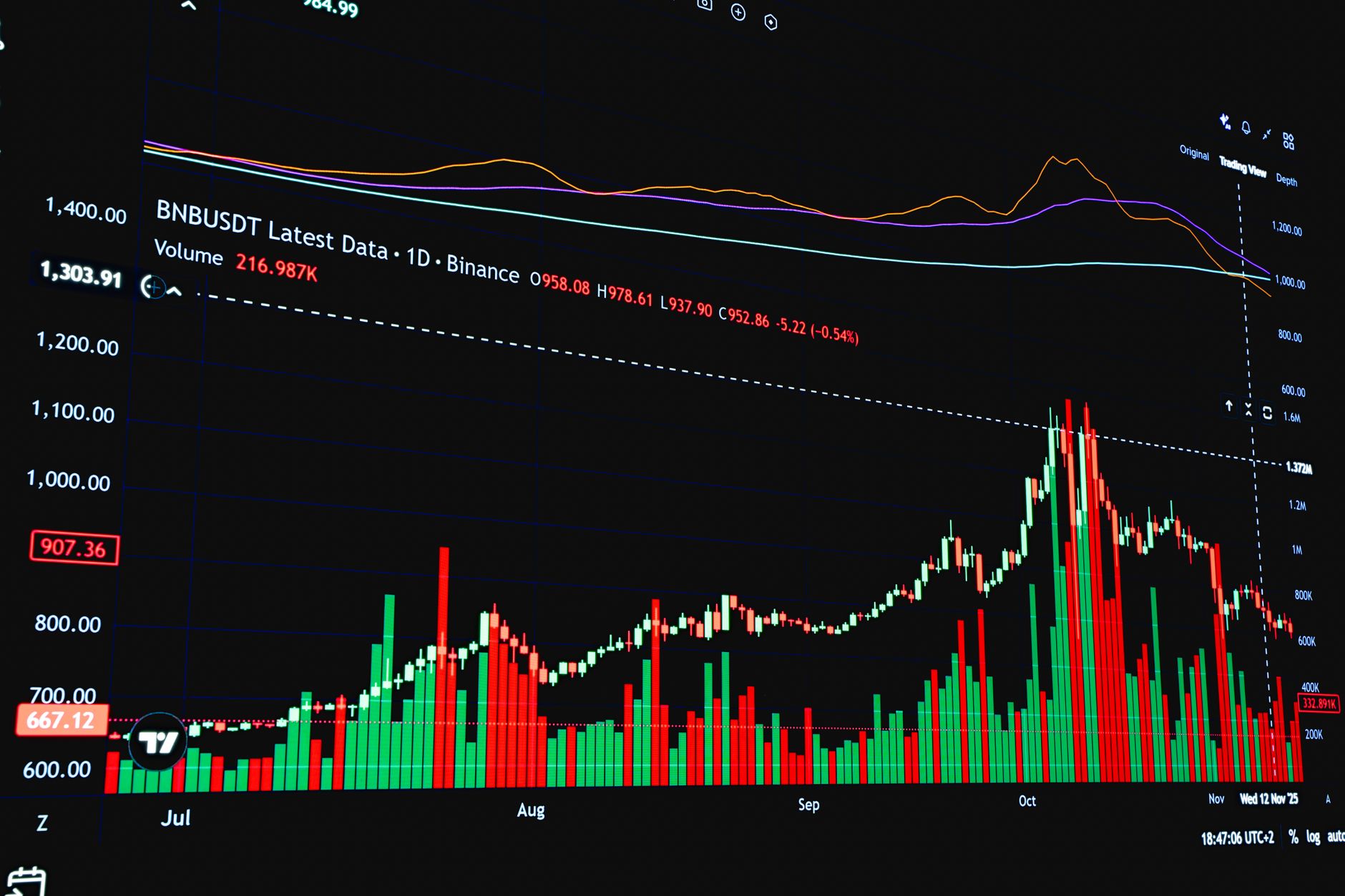
Bitcoin accumulation zones are price ranges where demand quietly outpaces selling pressure, typically after a sustained drawdown. Identifying them isn't about predicting the future with certainty. It's about recognising conditions that have, historically, preceded major price recoveries. For investors who understand how to read Bitcoin market cycles, accumulation zones are one of the most actionable concepts in the toolkit.
What an accumulation zone actually is
An accumulation zone is a price band where long-term holders and institutional buyers absorb supply from sellers who have lost patience. The price doesn't drop sharply. It consolidates, often for weeks or months, grinding sideways while volume remains relatively low on down days and slightly higher on up days. That asymmetry is the signal.
The term comes from Wyckoff market theory, developed by Richard Wyckoff in the early 20th century. Applied to Bitcoin, the core idea holds: markets move through four phases. Accumulation, markup, distribution, and markdown. Spotting accumulation before markup begins is where the edge lies.
Three conditions tend to appear together in a genuine accumulation zone:
- Price has declined 50% or more from a recent peak, shaking out leveraged and short-term positions.
- Selling volume is declining even as price stays flat or dips slightly.
- On-chain data shows long-term holders (wallets holding Bitcoin for more than 12 months) are accumulating, not distributing.
On-chain metrics that point to accumulation
Price charts alone don't tell the full story. Bitcoin's public ledger gives investors visibility that doesn't exist in traditional markets, and several on-chain metrics are particularly useful for confirming accumulation.
HODL waves track what percentage of Bitcoin's supply hasn't moved in a given period. When the 1-year-plus bands expand during a price drawdown, long-term holders are sitting tight or adding. That's accumulation behaviour.
Exchange outflows matter too. Bitcoin moving off exchanges suggests buyers intend to hold rather than sell quickly. Sustained net outflows during a consolidation phase are a consistent feature of accumulation periods. McLeod Pacific Investments tracks this kind of on-chain data to help clients understand where the market is in its cycle.
Realised price is the average price at which every Bitcoin last moved on-chain. When the spot price trades near or below the realised price, many holders are at or near breakeven. Historically, these zones have attracted buyers who recognise the statistical value.
Technical levels that define the zone boundaries
On-chain data confirms the macro picture. Technical analysis defines the specific price boundaries to watch. Three reference points are most reliable.
The 200-week moving average has acted as a floor in every major Bitcoin bear market on record. Price has dipped below it briefly during capitulation events in 2015, 2018, and 2022, but has not closed a monthly candle below it for any sustained period. That moving average is worth tracking.
Previous cycle highs also matter. Bitcoin repeatedly returns to test its prior bull market peak as support. In 2020, Bitcoin bounced hard from the 2017 high near $20,000 AUD equivalent. That price memory is embedded in the market's behaviour.
Volume profile visible range (VPVR) identifies price levels where the most Bitcoin has historically changed hands. High-volume nodes act as magnets and support levels. Low-volume zones above them can be traversed quickly once a breakout begins. This is why breakouts from accumulation zones sometimes look explosive: there's very little resistance in the overhead low-volume area.
Common mistakes when trying to call accumulation zones
The biggest mistake is confusing a falling price with an accumulation opportunity. Not every drawdown is a base. Some are the beginning of a prolonged markdown phase. The difference is in the structure: genuine accumulation shows decreasing volatility and shrinking trading ranges over time. A continuing markdown shows lower highs, lower lows, and expanding downside volume on red days.
Buying too early is the second pitfall. An accumulation zone isn't a single price point. It's a range, and it takes time to develop. Investors who try to catch the exact bottom often buy into a zone that continues lower. A better approach is to build a position gradually across the zone using a structured plan. McLeod Pacific Investments helps clients do exactly this, rather than making a single lump-sum decision at an arbitrary level.
Ignoring broader macro conditions is the third error. Bitcoin doesn't accumulate in a vacuum. Rising interest rates, tightening liquidity, and risk-off sentiment can extend accumulation phases far beyond what chart patterns alone suggest. A sound Bitcoin risk management framework accounts for these external forces rather than treating on-chain and technical signals as the whole story.
How to use accumulation zones in practice
Identifying an accumulation zone is step one. Acting on it sensibly is step two. A few practical principles apply.
Define your zone with a price floor and ceiling before buying anything. The floor is typically the most extreme capitulation wick. The ceiling is the upper boundary of the consolidation range. Spread purchases across that range rather than committing all capital at once.
Set a time budget, not just a price budget. Accumulation zones can last 6 to 18 months. Investors who run out of dry powder early get left behind. Reserve at least 30% of your planned position for the later stages of the zone, when the final shakeout often occurs.
Use a stop-loss or exit rule below your floor. If price breaks convincingly below the accumulation zone's lower boundary, the thesis has changed. A real accumulation zone holds. One that breaks down was likely a continuation pattern in disguise.
Finally, document your reasoning before you buy. Write down why you believe the zone is valid, what on-chain and technical indicators support it, and what would invalidate your view. That discipline separates strategic accumulation from wishful thinking. McLeod Pacific Investments offers Bitcoin education and trading support for investors who want to build this kind of structured approach from the ground up.