
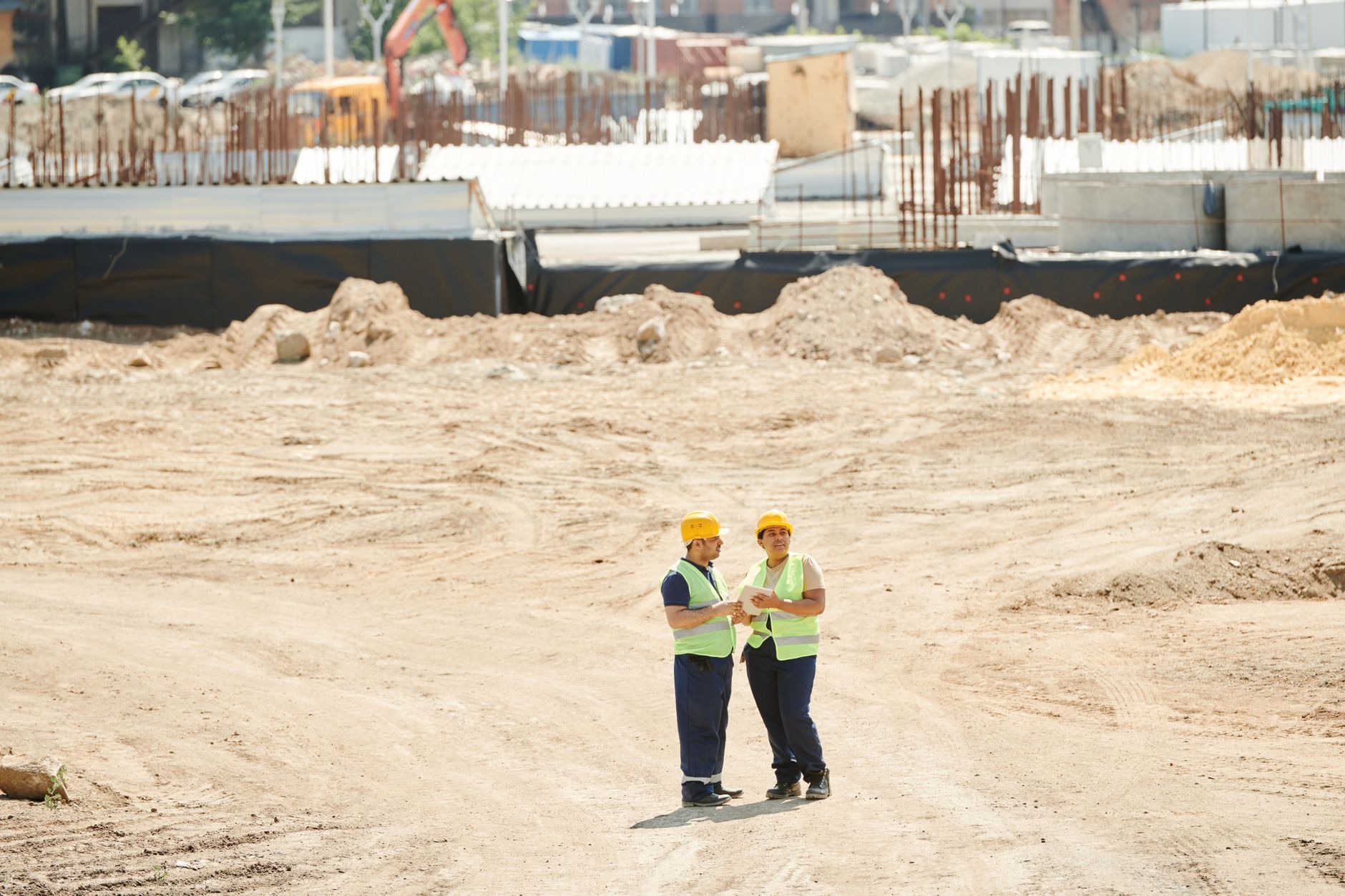
Bitcoin is making quiet inroads into the construction industry, and the reasons aren't hard to follow. Construction relies on a dense web of subcontractors, suppliers, equipment hirers, and project developers, many of them operating across state and national borders. Getting paid on time is a chronic problem in the sector. Bitcoin offers a way to settle invoices without waiting on banks, correspondent networks, or slow business payment cycles that can stretch to 60 or 90 days.
Why construction has a payments problem
Construction has one of the worst late-payment records of any industry in Australia. Subcontractors sit at the bottom of the payment chain, often waiting weeks after a milestone is signed off before money arrives in their account. Suppliers extend trade credit on the assumption they'll be paid within terms, and they often aren't. Project developers, particularly in residential construction, routinely move money through multiple entities before it reaches the people doing the physical work.
The industry also has a significant international dimension. Specialised equipment, engineered materials, and project finance frequently cross borders. A builder sourcing structural steel from overseas, or a developer raising capital from an international investor, faces currency conversion costs, bank transfer delays, and compliance friction that Bitcoin largely avoids.
Bitcoin settles in minutes, not days. It doesn't require a correspondent bank. It doesn't care whether sender and receiver are in Brisbane or Bucharest. For construction businesses dealing with international supply chains, that's a practical difference, not just a theoretical one.
How construction businesses are using Bitcoin
The most immediate use case is direct invoice settlement. A subcontractor completes a scope of work, issues an invoice priced in Australian dollars, and accepts Bitcoin as payment at the prevailing exchange rate. McLeod Pacific Investments supports exactly this kind of transaction, providing registered exchange services so both parties can convert between Bitcoin and AUD without leaving the regulated framework that Australian businesses require.
Equipment hire companies are another natural fit. Hire agreements are often short-term and high-frequency, which means payment friction gets multiplied across dozens of transactions on a single project. Bitcoin removes the need for accounts receivable staff to chase each one individually.
International procurement is a third area. A developer importing architectural cladding, specialist glazing, or custom joinery from Europe or South-East Asia faces wire transfer fees, exchange rate exposure, and processing windows that can stall production schedules. Bitcoin transfers the funds directly, at a known cost, on a predictable timeline.
What about volatility?
Bitcoin's price moves fast. That's a genuine concern for a construction business working to tight project margins. The practical answer is speed: accept Bitcoin, convert to AUD immediately, and carry zero residual exposure. McLeod Pacific Investments provides the exchange infrastructure to do exactly that.
Some construction businesses take a different view. A medium-sized developer with enough cash flow buffer might hold a small portion of Bitcoin receipts rather than converting immediately, treating it as part of a broader asset strategy. That's a business decision, not a payment decision. For most subcontractors and suppliers, the convert-on-receipt model removes the volatility question entirely.
Understanding Bitcoin and cross-border payments helps clarify how the settlement mechanics work in practice, including how exchange rates are typically handled at the point of transaction rather than after the fact.
Smart contracts and construction milestones
One of the more forward-looking applications in construction involves programmable payment logic. Construction contracts are built around milestones: slab down, frame up, lock-up, practical completion. Each milestone triggers a payment obligation. Automating that trigger reduces the administrative burden and removes the human delay between a certified milestone and an actual funds transfer.
Bitcoin's scripting capabilities allow for time-locked and condition-based transactions, though most of the sophisticated milestone automation in the industry currently runs on other blockchain platforms. Bitcoin's role is more often the settlement layer at the end of a more complex workflow. The result is the same: money moves faster once the work is done.
Compliance and the Australian context
Australian construction businesses operating with Bitcoin need to treat crypto receipts the same way they treat any other income. The ATO taxes Bitcoin as property, which means a subcontractor receiving Bitcoin for a completed scope is receiving income at the fair market value of the Bitcoin on the day of receipt. If the subcontractor later sells that Bitcoin at a higher price, the difference is a capital gain.
Good record-keeping matters. Construction businesses should log the AUD value of every Bitcoin transaction at the time it occurs, the wallet addresses involved, and the nature of the work it paid for. McLeod Pacific Investments operates as a registered Digital Currency Exchange Provider, which means transactions through McLeod Pacific Investments generate the kind of documented trail that Australian tax reporting requires.
For businesses newer to crypto, the Bitcoin for small businesses guide covers the operational basics in plain terms, including how to set up an exchange account and structure crypto receipts within a normal business workflow.
Practical steps for a construction business starting out
Getting started doesn't require a full treasury overhaul. Three steps cover most of what a construction business needs initially.
- Open an account with a registered Australian exchange like McLeod Pacific Investments and complete identity verification.
- Set a conversion policy: decide in advance whether Bitcoin receipts convert to AUD immediately or are held for a defined period.
- Add a Bitcoin payment option to invoices, with a clear note that the AUD invoice amount is fixed and the Bitcoin equivalent will be calculated at the time of payment.
Most accounting software used in construction, including Xero and MYOB, can be configured to record the AUD value of crypto receipts. The bookkeeping isn't complex. It's just unfamiliar to most construction finance teams, and familiarity comes quickly once the first few transactions are processed.
Where this is heading
Construction is a conservative industry by habit. It moves on demonstrated proof, not on early adoption enthusiasm. But the payment problems are real, the international supply chain friction is real, and Bitcoin's capacity to address both is documented across other industries that made the shift earlier. The logistics industry went through a similar adoption curve, with freight companies finding that Bitcoin's cross-border settlement advantages outweighed the unfamiliarity of implementing a new payment method.
Construction will get there at its own pace. The businesses that work out the operational details now, while Bitcoin adoption is still relatively low in the sector, will be better placed to compete for subcontractors and suppliers who start to price payment speed into their quotes. Fast payment is increasingly part of the value proposition, not just a nice-to-have.